About this case study. Sterling is an illustrative composite and the figures are modeled, because our client work is confidential. The analysis is real: every number on this page is computed from a modeled scenario, and both bridges reconcile. The pattern is one we see constantly with owners approaching a sale.
The results, up front
| Measure | Value |
|---|---|
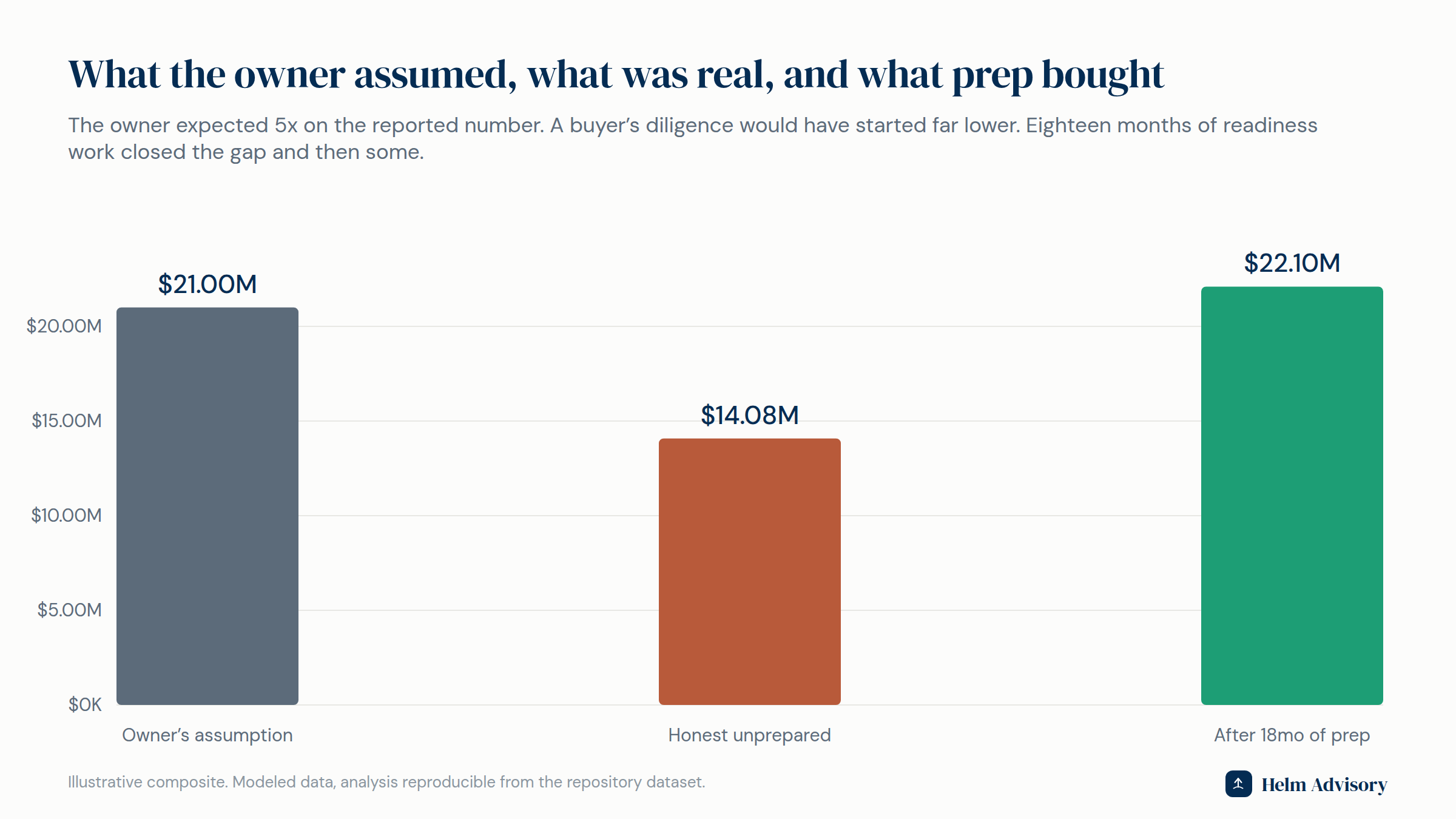
| Owner's assumption (5x on reported EBITDA) | $21.0M |
| Honest unprepared value (what a buyer would start at) | $14.1M |
| Value after 18 months of readiness work | $22.1M |
| Value created versus the unprepared starting point | +$8.0M |
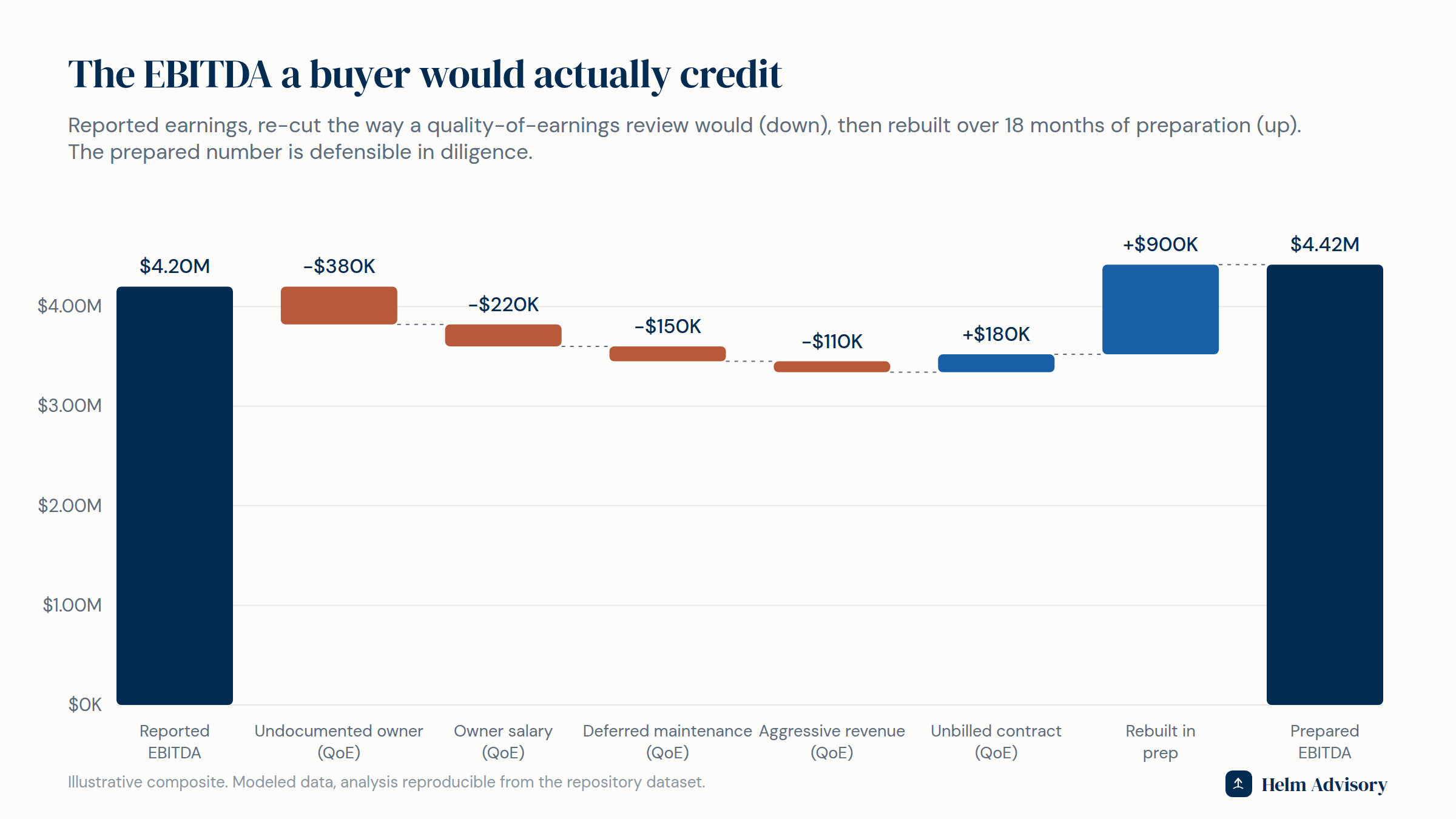
| Reported EBITDA | $4.20M |
| EBITDA a buyer's QoE would credit (unprepared) | $3.52M |
| Defensible EBITDA after preparation | $4.42M |
The company
Sterling is a forging and machining manufacturer, about $30M in revenue. The owner is 61 and had started, quietly, to think about a sale in the next two or three years. He had a number in his head: $4.2M of EBITDA, times a 5x multiple he had heard was normal for the industry, so roughly $21M.
The symptom
There was no crisis. That is what makes this the most expensive kind of gap, because nothing forces you to look at it. The owner assumed his reported earnings were the earnings a buyer would pay for, and that his business would trade at the multiple he had heard at a conference. Both assumptions were optimistic, and he would not have learned that until the worst possible moment: the middle of a live deal, across the table from a buyer's diligence team.
We ran a sell-side readiness review, which is a mock version of what that team would do, 18 months early.
What the data showed
A buyer's quality of earnings review would have cut the EBITDA. A QoE rebuilds reported earnings from the bottom up. On Sterling's numbers it would have struck undocumented add-backs, normalized the owner's under-market salary, adjusted for deferred maintenance, and unwound some aggressive revenue timing. Net, the $4.2M reported became about $3.52M a buyer would credit.
The multiple would have compressed too. The 5x the owner assumed is for a clean, low-risk business. Sterling had a top customer at 34% of revenue, deep owner-dependence, a thin management layer, and no forecast with a track record. A buyer prices each of those as risk, and risk comes off the multiple. The honest unprepared profile traded closer to 4.0x.
So the real starting point was $3.52M times 4.0, about $14.1M, not the $21M in the owner's head. A $7M gap he had no idea existed.
What changed
Eighteen months of work, on both halves of the valuation:
- Rebuild the EBITDA a buyer will credit. Document every add-back with a paper trail so it survives diligence. True up the unbilled escalators. And do the real operating work, pricing and scrap discipline, that grows genuine earnings. Defensible EBITDA came back to about $4.42M.
- Expand the multiple by removing risk. Widen the customer base so the top account fell from 34% to 21% of revenue. Build a management layer that runs the business, so the owner-dependence discount shrinks. Produce clean monthly financials and a forecast with a year of accuracy behind it. That work moved the profile back toward 5.0x.
What happened
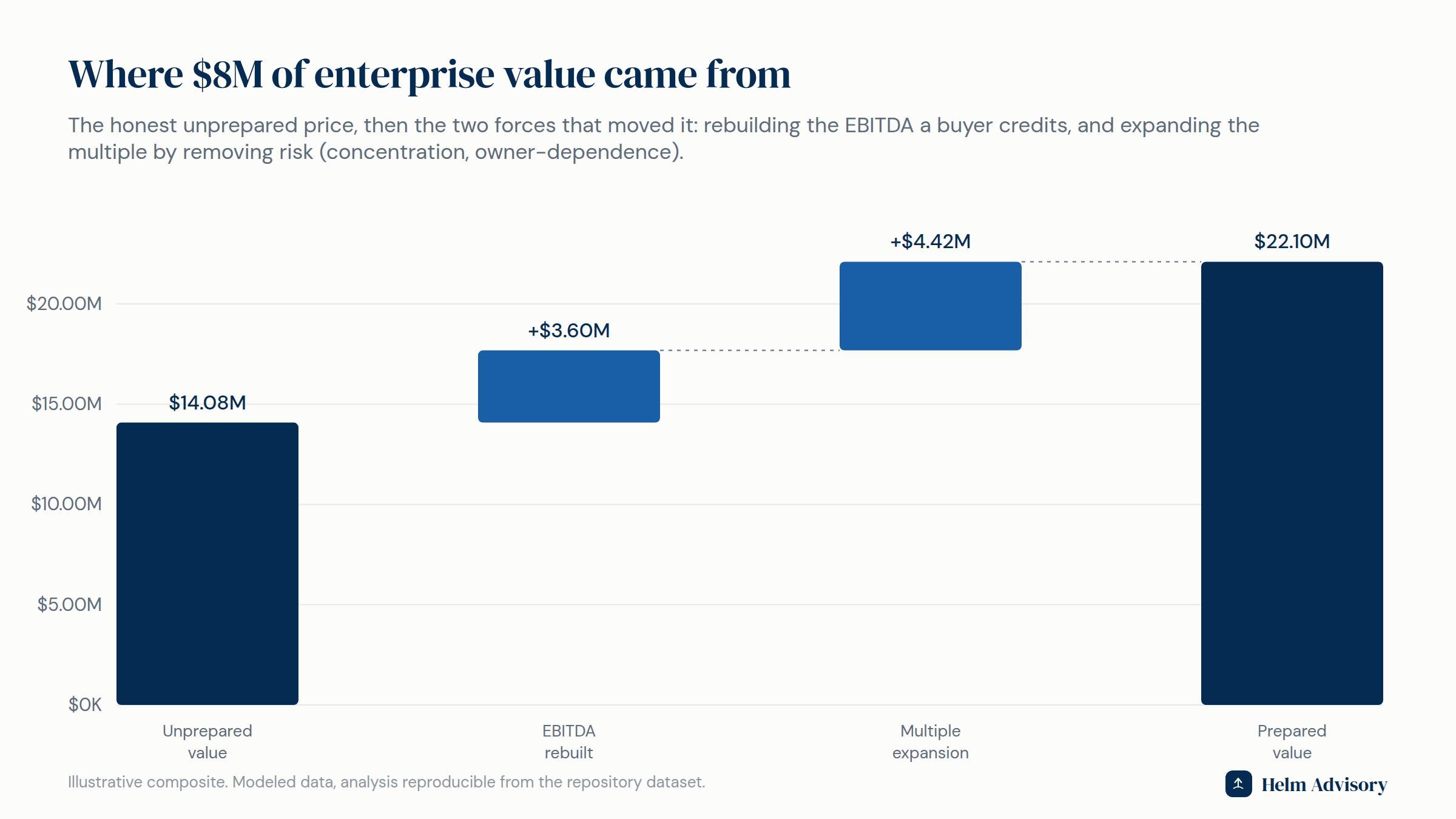
The prepared business was worth about $22.1M, against the $14.1M a buyer would have started at 18 months earlier. Roughly half of the $8M came from rebuilding the EBITDA a buyer credits, and half from expanding the multiple by removing risk. The deal also did not re-trade. There were no surprises left to find.
The lesson
The owner's original $21M was not wrong because his business was bad. It was wrong because he was pricing his reported number at a clean-business multiple, and a buyer prices the number they can defend at the multiple the risk earns. The gap between those two is not luck. It is 18 months of specific, unglamorous work, which is exactly why exit readiness is a multi-year project and not a deal-year scramble.
If a sale or transition is anywhere on your horizon, the two-minute Exit-Readiness Scorecard will show you roughly where you would stand today, and our Strategy and Transition work is built to close exactly this kind of gap while there is still time.
Methodology: a modeled scenario with the QoE adjustment schedule, the preparation schedule, and the two-factor value math (EBITDA credited times multiple). Both the EBITDA bridge and the value bridge reconcile. Composite prepared so the mechanics can be shown with a specificity confidential client work does not allow.